Folding-Arm Awnings
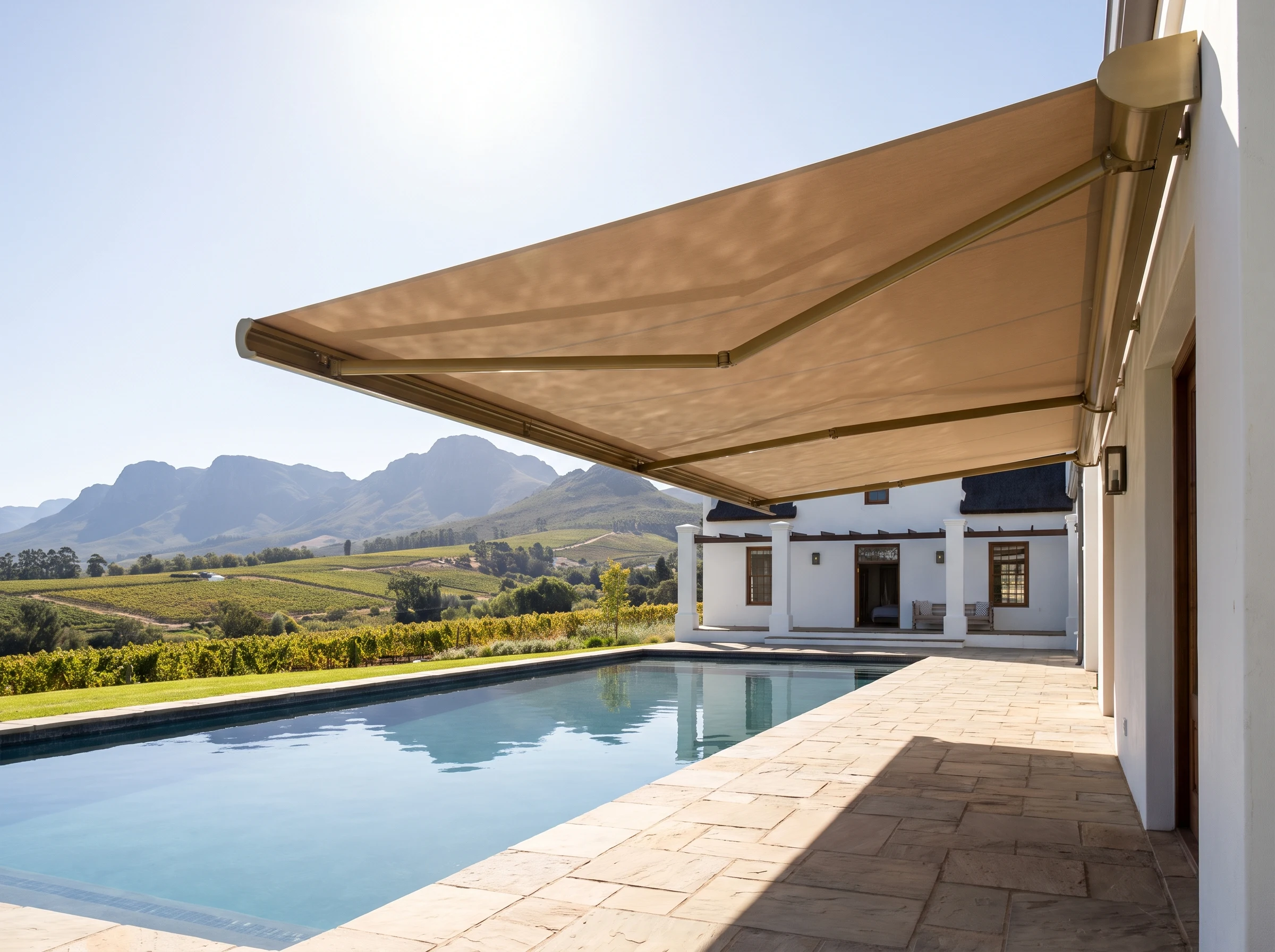
A folding-arm awning is a retractable fabric canopy on spring-tensioned arms — no posts, no permanent roof, shade on demand over a patio, deck or entertaining terrace, disappearing into a cassette when it's not needed. It turns a north- or west-facing terrace back into a usable room through the Winelands summer, then retracts to let the same terrace catch welcome winter sun — a seasonal argument a fixed roof simply can't make.
Why it earns its place on an estate terrace
Estate homes are built around the entertaining terrace as much as any interior room — main house glass opening directly onto it, often with a pool or braai area immediately beyond. No posts means no interrupted fairway or vineyard view and no clutter around the braai. That reads clearest on the Stellenbosch estate belt, where the newer estate builds run their glass walls straight out at the vineyard rows and there is nothing out there you would want a post standing in front of. Projection runs to roughly 3–4m over wide spans, which suits the generous terrace footprint most estate stands are built with.
An awning cassette is visible on the elevation when retracted, so we specify the housing colour and mounting detail against your estate's guidelines before ordering. A full cassette (fabric and arms sealed away) tends to present the cleanest closed profile for review.
What you're specifying
- Full cassette, semi-cassette or open mounting — full cassette suits weather-exposed, wind-prone positions and estate elevations that want the tidiest closed look.
- Motor and wind sensor as the responsible spec — an awning caught open in a mountain gust, or in the evening katabatic wind that drops into the Franschhoek valley estates after sunset, can be destroyed; auto-retract protects the investment on every install we do.
- Solution-dyed acrylic fabrics that hold colour under Cape UV, in tones matched to your estate's approved palette.
- LED lighting and a vertical drop-valance add-on on premium lines, for terraces that get used after dark.
Honest limitations
An awning is a shade product, not a rain product — it copes with light drizzle at a working pitch, never storm rain or standing water. Wind ratings are real limits, not suggestions, which is exactly why the sensor spec matters this much on open estate frontage. The fixing substrate (brick, timber or steel) changes the installation detail, so a proper site assessment happens before quoting, not after.
Where it fits alongside the rest of the range
On terraces with any exposure to wind on more than one side, we usually pair the awning's overhead shade with zip screens on the open flank for a fully enclosed outdoor room. Where the terrace sits under a frameless glass wall, an external venetian on that same wall keeps the interior comfortable while the awning handles the terrace itself.
Products that work alongside folding-arm awnings
What it costs
Priced on the area it shades
An awning is costed on width multiplied by projection, and the guide, installed, is R3,500 to R5,500 per square metre for a crank-handle unit and R5,500 to R7,500 per square metre motorised with a wind sensor. A full cassette that folds the fabric away, and the deeper projections, both sit near the top of their band.
A short awning over one door carries a minimum charge, because the arms, the cassette and the wall fixing are the same job at any width. Fabric colour is usually the part an estate has an opinion about, so it is specified to the approved palette where one exists, and the exposure of the terrace is read at the free measure before the price is written.
Get the terrace shaded before summer
Free in-home measure, a written quote by width and projection, and a fascia colour matched to your estate.