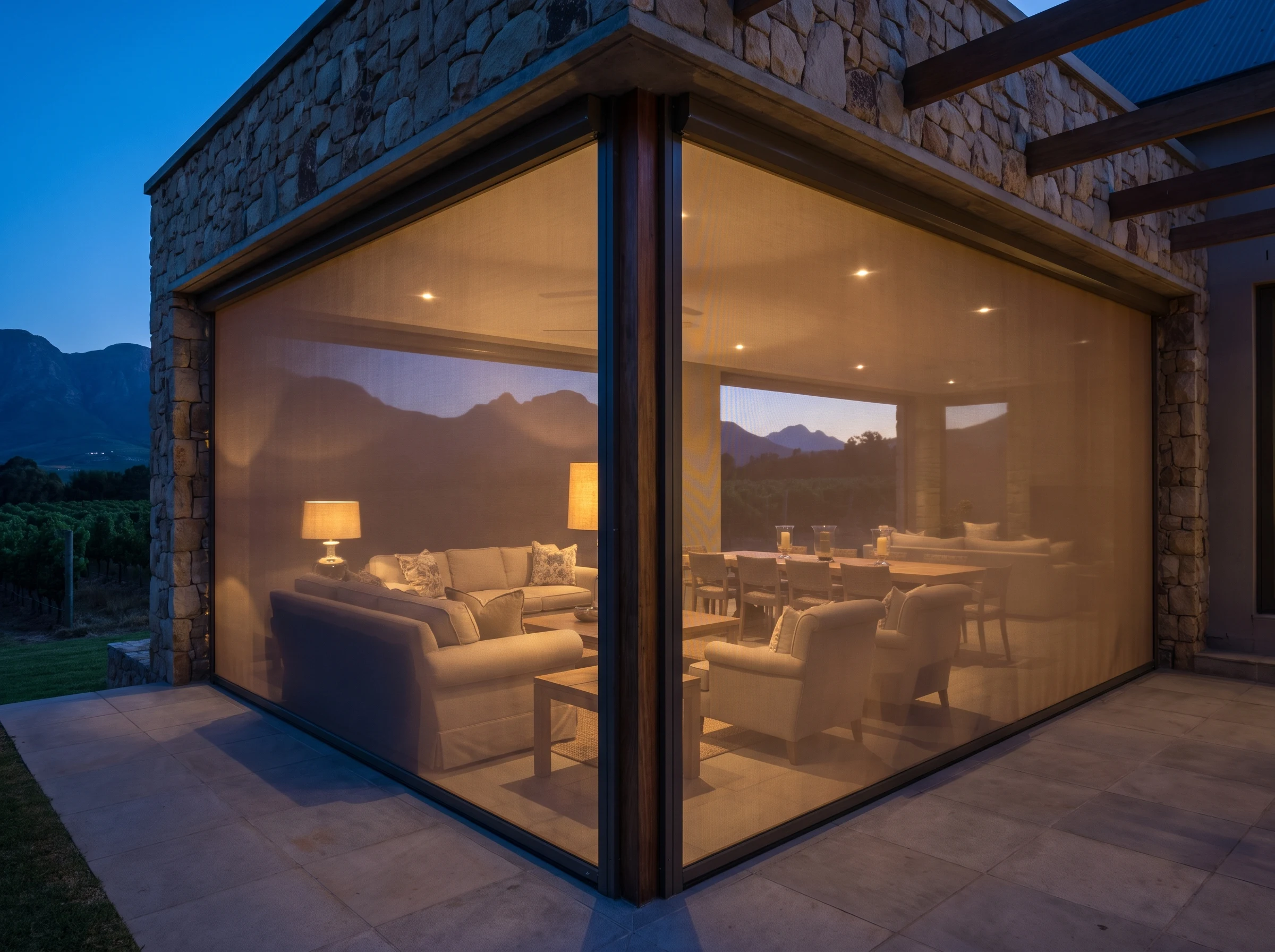
Zip Screens
A zip screen is a vertical exterior screen running in zipped aluminium side channels — mesh or PVC fabric locked tight on both edges, sealing a terrace, patio or covered braai area against sun, wind and insects. The zip is the whole point: an ordinary drop roller flaps and escapes its guides in real wind; a zipped screen holds tension and stays put. It's the product that turned a covered terrace into a usable outdoor room, year-round.
Why the Winelands specifically wants the zip
The coastal south-easter that defines Cape Town's outdoor-living argument fades well before it reaches most Winelands estates. But every valley in the basin runs its own local wind off its own mountains. On the Stellenbosch estate belt, a Paradyskloof-side patio takes gusts funnelled straight off the Simonsberg and the Helderberg, on top of whatever the coastal south-easter still has left in it by then. The Paarl estate belt sits against the Klein Drakenstein and Groot Drakenstein and takes its gusts from there, while Wellington estate country gets its own down off Bain's Kloof. And in the Franschhoek valley estates the wind arrives after dark, draining off a valley closed on three sides. Different source, same consequence: an entertaining terrace on open estate frontage needs a screen that won't flap loose the first evening the wind picks up.
Zip screens sit inside an existing covered structure rather than changing the roofline or facade, which usually makes them one of the more straightforward exterior products to get past a committee review — but colour-matching the aluminium channels to your estate's fascia guidelines is still worth confirming before we order.
What you're specifying
- Sunscreen mesh (in a range of openness factors) — keeps the view out, cuts glare and UV, and adds daytime privacy while the estate's fairway or vineyard stays visible.
- Clear PVC or crystal panels — a wind-and-rain-proof enclosure for a winter braai room that still keeps the mountain view.
- Blockout options where the goal is an outdoor cinema evening or killing hard west sun on a specific opening.
- Motorisation as standard on wide spans, with wind-sensor retract for exposed positions — spans run to 4m-plus per screen.
Honest limitations
Zip screens are a mid-to-premium spend per opening, and a multi-screen terrace enclosure is a genuinely big-ticket item — worth budgeting for as one job rather than screen-by-screen. They enclose an existing covered space; they don't replace a roof or a structural wall, so a fully open terrace needs that covered structure first.
Where it fits alongside the rest of the range
Most estate terraces pair a folding-arm awning for shade overhead with zip screens on the open side or sides for wind and privacy — the two solve different problems and work well together. Where the terrace sits directly beneath a frameless glass wall, an external venetian on that wall keeps the interior comfortable while the zip screens handle the terrace itself.
Products that work alongside zip screens
What it costs
What closing in a terrace costs
A zip screen holds its mesh under tension inside side channels, which is more hardware than an open outdoor blind and precisely why it copes where an awning arm cannot. Installed, the guide runs R2,800 to R4,500 per square metre on a crank and R4,000 to R6,000 per square metre with a motor.
Weave openness, the channel system and whether one opening is closed or a corner turned all decide where inside that band a screen falls, and narrow screens carry a minimum charge. Because the channels are fixed to the structure, this is another product that usually goes through estate approval, and the specification for that is prepared alongside the written quote.
Turn the terrace into a year-round room
Free in-home measure, a written quote per opening, and colour-matched channels for your estate.